If you buy through retail links on Ember & Edge, we may earn an affiliate commission at no additional cost to you. How affiliate partnerships support our site
Engraving metal is one of the most rewarding milestones in desktop fabrication, but it is also where many makers hit unexpected hurdles. The central challenge comes down to basic physics: different laser wavelengths interact with metals in completely different ways. While an organic material like wood absorbs almost any laser beam, reflective and conductive metals require either immense thermal energy, specific light wavelengths, or specialized chemical coatings to take a permanent mark.
When searching for a laser engraver for metal, you will primarily encounter two distinct technologies on the desktop market: blue diode lasers (typically operating around 450 nm) and fiber lasers (typically around 1064 nm). Understanding how these systems differ in wavelength, mechanical movement, and material capabilities is the single most important step before investing your workshop budget.
The Core Physics: Diode vs. Fiber on Bare Metal
Before comparing specific desktop models, it helps to understand why the laser source dictates what you can achieve on metal surfaces:
- Blue Diode Lasers (~450 nm): These visible-light lasers are widely popular on open-frame gantry rigs. A diode beam will readily mark coated, painted, or anodized metals (such as anodized aluminum tags or powder-coated tumblers) by vaporizing the surface coating. However, when aimed at bare, untreated, reflective metals (like polished aluminum, copper, or brass), the energy largely reflects away. Higher-power blue diodes (such as 20W optical output) can produce high-contrast marks on certain bare metals like stainless steel through thermal oxidation, but they cannot perform true relief engraving or deep cuts into metal sheets.
- Fiber Lasers (~1064 nm): Operating in the near-infrared spectrum, fiber lasers deliver a wavelength that untreated metals readily absorb. Combined with galvo-mirror scanning heads that steer the beam at rapid speeds, fiber units excel at deep engraving, crisp surface annealing, high-contrast black marking, and even micro-cutting thin precious metals like jewelry blanks.
For a broader comparison of workshop gantry styles and enclosures across various cutting materials, see our desktop laser cutter machines guide.
Comparing Desktop Options: Diode Gantry vs. Galvo Fiber
The two machines below illustrate how these technical approaches translate into practical workshop setups, from budget entry points to dedicated industrial-style marking stations.
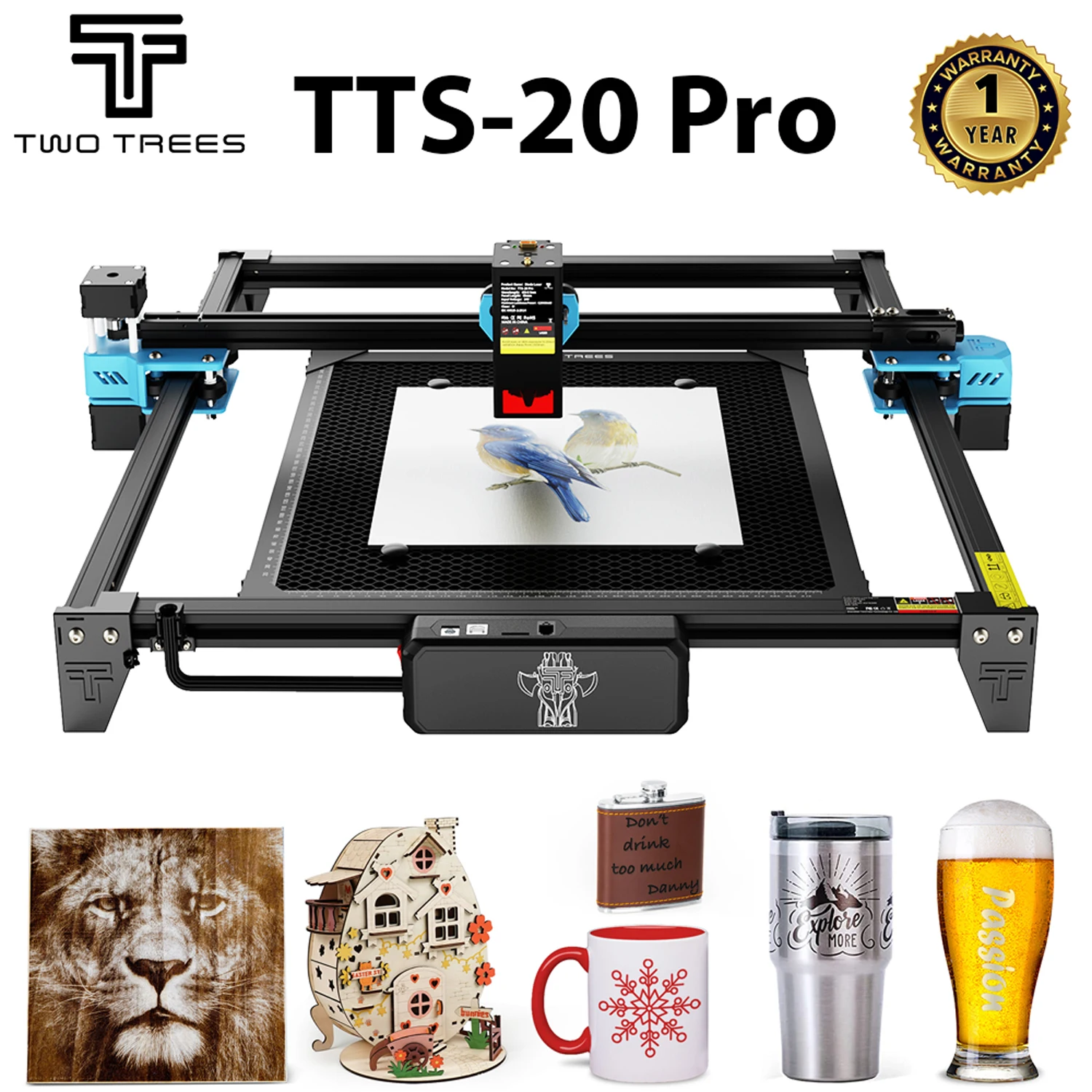
Twotrees TTS-20 Pro: Gantry Diode for Versatile Marking
The Twotrees TTS-20 Pro represents the high-power end of open-frame diode engravers. Advertised with a 20W blue light laser module, offline Wi-Fi control, and CNC-style gantry motion, it provides a large working envelope common to flatbed gantry frames.
Metal capabilities and realistic boundaries: Because the TTS-20 Pro uses a blue diode source, its primary strength lies in engraving coated metals, dark anodized aluminum, and thermal marking on stainless steel. It is also an adaptable multipurpose tool if your workshop splits time between wood, acrylic, leather, and occasional metal marking. However, buyers should not expect it to deeply engrave bare brass, copper, or silver, as visible blue diode light does not have the absorption profile or pulse peak power required for metal vapor removal.

DAJA S4: Portable Galvo Fiber for Bare Metal & Jewelry
The DAJA S4 belongs to the fiber laser marking machine category, available in advertised power options spanning 20W, 30W, and 50W. Rather than using an X/Y gantry with belts and wheels, machines of this type utilize stationary galvo mirror heads to deflect the beam across a targeted marking field.
Metal capabilities and realistic boundaries: The DAJA S4 is specifically targeted toward direct metal marking, including jewelry engraving, bare metal identification tags, tool branding, and select dense plastics. With its fiber source, it can interact directly with untreated metals that reflect diode light. The primary trade-off is the physical marking envelope: galvo fiber units typically feature a much smaller focal field than gantry machines, making them tailored for small parts, jewelry, serial plates, and compact components rather than large panels.
| Feature / Aspect | Twotrees TTS-20 Pro | DAJA S4 (20W/30W/50W) |
|---|---|---|
| Laser Source Type | Blue diode (advertised 20W blue light) | Fiber laser (advertised 20W, 30W, or 50W options) |
| Typical Motion Architecture | Gantry (belt/rail CNC framework) | Galvanometer optical scanning head |
| Bare Metal Marking | Limited (mainly stainless steel thermal marking; requires sprays for other bare metals) | Direct surface marking and engraving on bare metals (steel, brass, aluminum, gold, silver) |
| Coated / Anodized Metals | Excellent (strips coatings, high contrast on anodized layers) | Fast ablation and marking |
| Organic Materials (Wood, Leather) | Supported (cuts and engraves standard craft materials) | Limited (fiber light passes through or scorches many organics unpredictably; handles select plastics/leather) |
| Price & Investment Tier | Entry desktop range (reference listing ~$343 USD) | Dedicated industrial/business tier (reference listing ~$1,375 USD) |
What to Verify Before Purchasing a Metal Engraver
Because marketplace titles often group multiple configuration options under a single page, always clarify the following points with the seller before placing an order:
- Optical vs. Electrical Wattage: Ensure the advertised power rating reflects optical output power at the beam rather than total wall-plug electrical consumption. While the Twotrees listing designates a 20W class laser module, always confirm the exact optical rating of the module included in the selected package.
- Fiber Source Brand and Pulse Type: For units like the DAJA S4, fiber laser sources differ significantly in beam quality, pulse duration, and frequency range (e.g., standard Q-switched vs. MOPA sources). MOPA sources allow adjustable pulse widths that can produce color marking on stainless steel and deep contrast on dark plastics, whereas basic Q-switched sources have fixed pulse widths. Check the listing option to determine which source type is installed.
- Field Size and Lens Specifications: Galvo fiber engravers rely on an F-theta field lens. A standard lens might offer a 110×110 mm or 150×150 mm marking area. If your projects involve longer parts, check whether larger lenses or rotary attachments are supported.
- Laser Safety Enclosures and Filtration: High-power blue light and infrared fiber beams pose severe eye hazards from direct reflections off polished metal. Fiber engravers operate at 1064 nm (invisible to the human eye), requiring specialized protective glasses rated specifically for optical density (OD) at that wavelength. Verify whether an enclosure or certified eyewear matches your machine's exact wavelength before powering it on.
Frequently Asked Questions
Can a 20W diode laser cut metal?
No. Even high-power desktop diode lasers cannot cut structural metal sheets. They lack the beam energy density and gas assist integration needed to melt and clear molten metal. At best, a 20W optical diode can cut extremely thin metal foil (fractions of a millimeter) under specific, non-standard conditions, but it is fundamentally a surface marking tool for coated metals or stainless steel.
Do I need laser marking spray for stainless steel?
On a fiber laser like the DAJA S4, marking sprays are completely unnecessary; the laser directly alters the bare metal. On a diode engraver like the Twotrees TTS-20 Pro, high optical power (20W) can produce a dark oxidation mark on clean stainless steel without additives, but marking sprays or thermal bonding pastes remain helpful if you want darker, more uniform contrast or wish to mark highly reflective metals like bare brass or raw aluminum.
Which machine is better for personal jewelry making?
If you intend to mark rings, pendants, silver ingots, or brass tags, a fiber marking machine is the proper tool. The near-infrared wavelength cuts cleanly into noble metals, allows deep micro-engraving, and handles polished surfaces without skipping or reflecting harmlessly away.
Evaluation is based on published specifications and seller listings. No physical or hands-on testing was conducted; unlisted specifications may still be available from the seller.